One moment
We’re getting things ready for you.
We’re getting things ready for you.
Learn more about Fountain of Youth, including what it is, how it works, what it has been studied for, safety considerations, and how clinician-supervised treatment works through ElliotMeds.
Prescription requires licensed-provider review. No guaranteed outcomes.
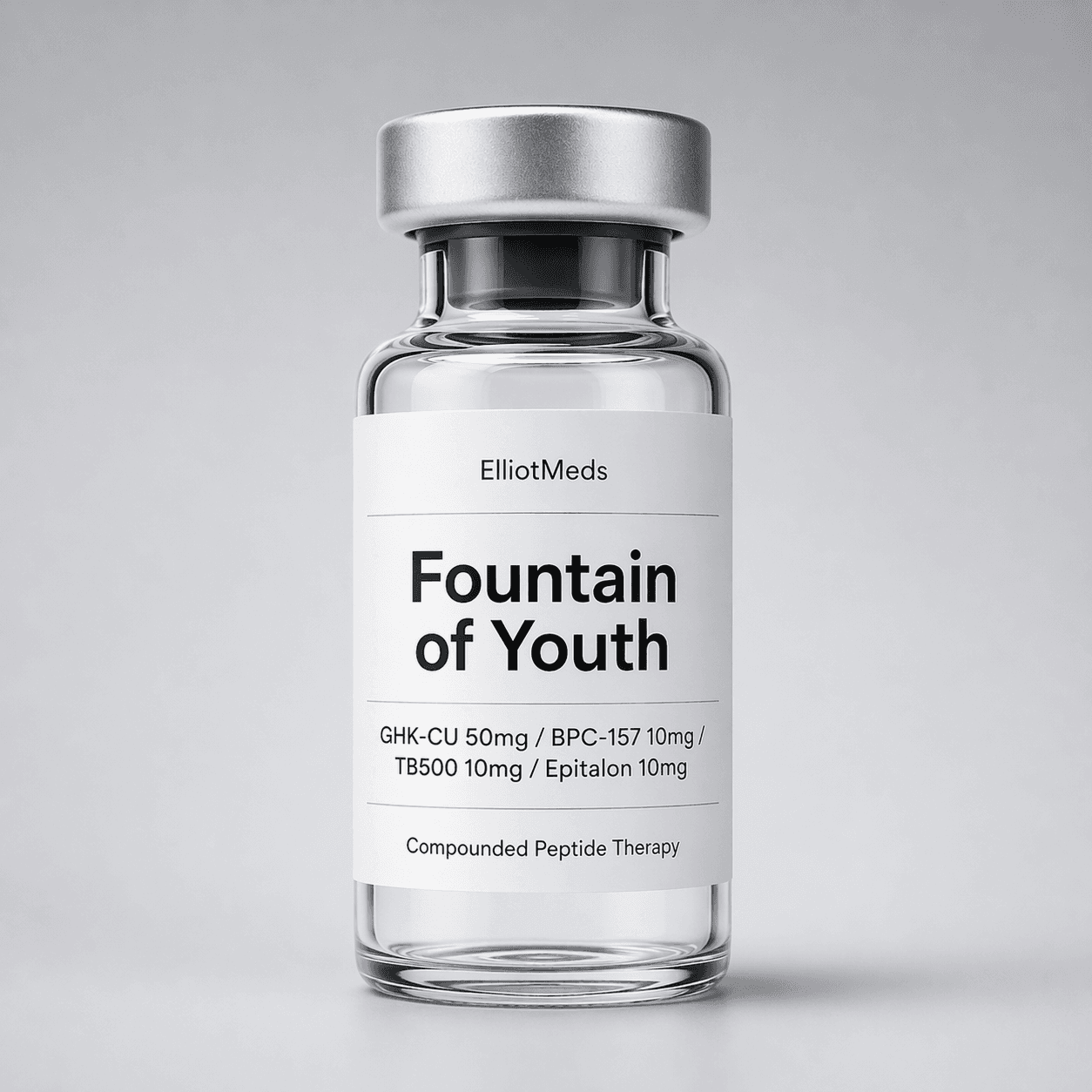
Ready to get started? View Fountain of Youth pricing, dosage options, and start a provider chart review on the treatment page.
View Treatment OptionsFountain of Youth is a compounded multi-peptide blend combining GHK-Cu, BPC-157, TB-500, and Epitalon, offered for clinician-supervised recovery and longevity discussion. This page is educational and not medical advice.
Last updated: July 2, 2026
This blend combines four peptides: GHK-Cu (a copper-binding tripeptide studied in skin and tissue-remodeling research), BPC-157 (a synthetic peptide studied in preclinical repair models), TB-500 (a fragment related to thymosin beta-4), and Epitalon (a synthetic tetrapeptide discussed in longevity research). The blend is not FDA-approved, and its components differ widely in evidence and regulatory status.
GHK-Cu is studied for signaling related to collagen, elastin, and tissue remodeling; BPC-157 and TB-500 are studied in preclinical tissue-repair models; Epitalon is discussed in preliminary research around pineal/telomere-related pathways. The combined mechanism in humans is not an established clinical effect.
GHK-Cu has research in skin remodeling and wound healing (much of the strongest use is topical/cosmetic); BPC-157 and TB-500 are preclinical-dominant; Epitalon has very limited, largely preclinical or early human research, and its longevity/anti-aging claims are not established. None of these injectable uses is FDA-approved, and the blend has no controlled human outcome trials.
The FDA has flagged BPC-157 in its 503A bulk-substance review (Category 2, safety concerns); BPC-157 and TB-500-related substances have been part of FDA compounding-safety discussions and are WADA-prohibited for athletes; injectable GHK-Cu and Epitalon have limited human safety data. Compounding availability is subject to each component's status.
Use is provider-directed only; no anti-aging, longevity, or recovery outcome or timeline is promised, and effects are individual and unverified for these purposes.
Many patients begin with a lower starting option so a licensed clinician can evaluate tolerance, medical history, goals, and safety factors before any adjustments are considered. The starting option shown below is informational and reflects available program data, not self-directed dosing instructions. Final medication, dose, frequency, and treatment plan are determined by a licensed clinician.
Average starting option
Available options
Provider note: Do not change dose, frequency, or route of use unless directed by your clinician.
Important note
Some treatments may involve compounded medications when prescribed by a clinician. Compounded medications are not FDA-approved. The FDA does not evaluate compounded medications for safety, effectiveness, or quality before marketing.
A clinician reviews skin/collagen and recovery goals, copper-related and liver considerations, cancer history, immune status, pregnancy status, allergies, and medications before considering the blend, and may determine it is not appropriate.
Compared with any single component, the blend layers four peptides of differing and largely preliminary evidence, increasing uncertainty and additive-risk considerations. None is presented as superior.
No — the blend is not FDA-approved, and its injectable components are not FDA-approved for these uses.
GHK-Cu, BPC-157, TB-500, and Epitalon.
Additive risks including injection-site/hypersensitivity reactions, copper considerations, immunogenicity, and purity concerns, with limited human data.
No — a licensed clinician decides.
Disclaimer
Although the information on this page is based on available educational research and product information, it is provided for informational purposes only and is not medical advice. Treatment decisions, medication selection, dosing, and eligibility are determined by a licensed clinician after review. Not all patients are candidates, and individual results may vary. Use medications only as directed by your clinician.
Next step
Begin by reviewing the treatment option and completing the secure provider chart review process.