One moment
We’re getting things ready for you.
We’re getting things ready for you.
Learn more about Retatrutide, including what it is, how it works, what it has been studied for, safety considerations, and how clinician-supervised treatment works through ElliotMeds.
Prescription requires licensed-provider review. No guaranteed outcomes.
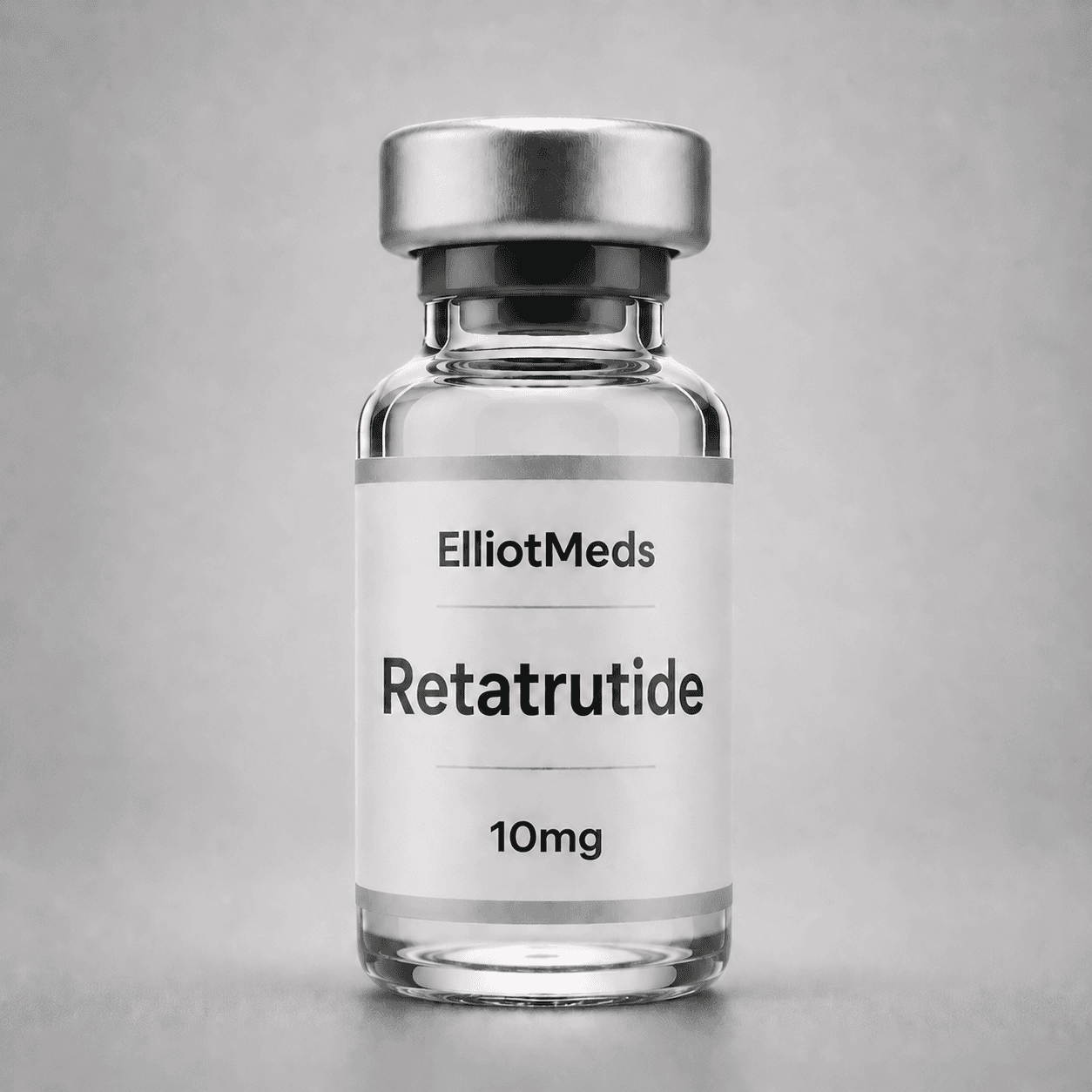
Ready to get started? View Retatrutide pricing, dosage options, and start a provider chart review on the treatment page.
View Treatment OptionsRetatrutide is an investigational triple-hormone-receptor agonist being studied for weight management and metabolic disease. It is not FDA-approved for any use. This page is educational and not medical advice.
Last updated: July 2, 2026
Retatrutide is an investigational drug designed to activate three receptors — GIP, GLP-1, and glucagon. It has not been approved by the FDA for any indication and remains in clinical development. It is not a branded product and is not an approved medication; any discussion of it occurs only with a licensed provider, where clinically appropriate and legally available.
Retatrutide is being studied for combined activity at the GIP, GLP-1, and glucagon receptors. GIP and GLP-1 pathways are involved in appetite and insulin signaling; glucagon-receptor activity is being investigated for possible effects on energy expenditure and metabolism. Because retatrutide remains investigational, this is not an established treatment mechanism, and its effects in general patient use are not established.
Retatrutide is being evaluated in ongoing clinical trials for obesity and related metabolic conditions. Its safety, effectiveness, approval status, labeling, and eventual therapeutic role all remain under investigation, and human data are early. This page does not present outcome figures because retatrutide is not approved and its efficacy is not established for general use.
Because retatrutide is investigational, no approved use, dosing, timeline, or expected outcome can be represented. Long-term and real-world safety are not established. Treatment is not guaranteed and is not equivalent to any FDA-approved medication.
Many patients begin with a lower starting option so a licensed clinician can evaluate tolerance, medical history, goals, and safety factors before any adjustments are considered. The starting option shown below is informational and reflects available program data, not self-directed dosing instructions. Final medication, dose, frequency, and treatment plan are determined by a licensed clinician.
Average starting option
Available options
Provider note: Do not change dose, frequency, or route of use unless directed by your clinician.
Important note
Some treatments may involve compounded medications when prescribed by a clinician. Compounded medications are not FDA-approved. The FDA does not evaluate compounded medications for safety, effectiveness, or quality before marketing.
Given its investigational status, retatrutide is not an established treatment for any population. A licensed clinician reviews weight history, metabolic and cardiovascular status, gastrointestinal/pancreatitis/gallbladder history, pregnancy status, current medications, and legal availability, and may determine it is not appropriate.
Semaglutide acts on one receptor (GLP-1); tirzepatide on two (GIP and GLP-1); retatrutide is being studied as a three-receptor agonist (GIP, GLP-1, glucagon). Unlike the other two, retatrutide is not FDA-approved in any form. No comparative effectiveness is claimed.
No. It is investigational and not approved for any use.
It is not an approved medication; it may only be discussed with a licensed provider where clinically appropriate and legally available.
It is being studied as a triple agonist (GIP, GLP-1, glucagon); its mechanism in general use is not established.
No — different investigational mechanism, and unlike those two it is not FDA-approved.
Disclaimer
Although the information on this page is based on available educational research and product information, it is provided for informational purposes only and is not medical advice. Treatment decisions, medication selection, dosing, and eligibility are determined by a licensed clinician after review. Not all patients are candidates, and individual results may vary. Use medications only as directed by your clinician.
Next step
Begin by reviewing the treatment option and completing the secure provider chart review process.